Assignment 2A
Janesta Lewis
IED 336
Lesson plan
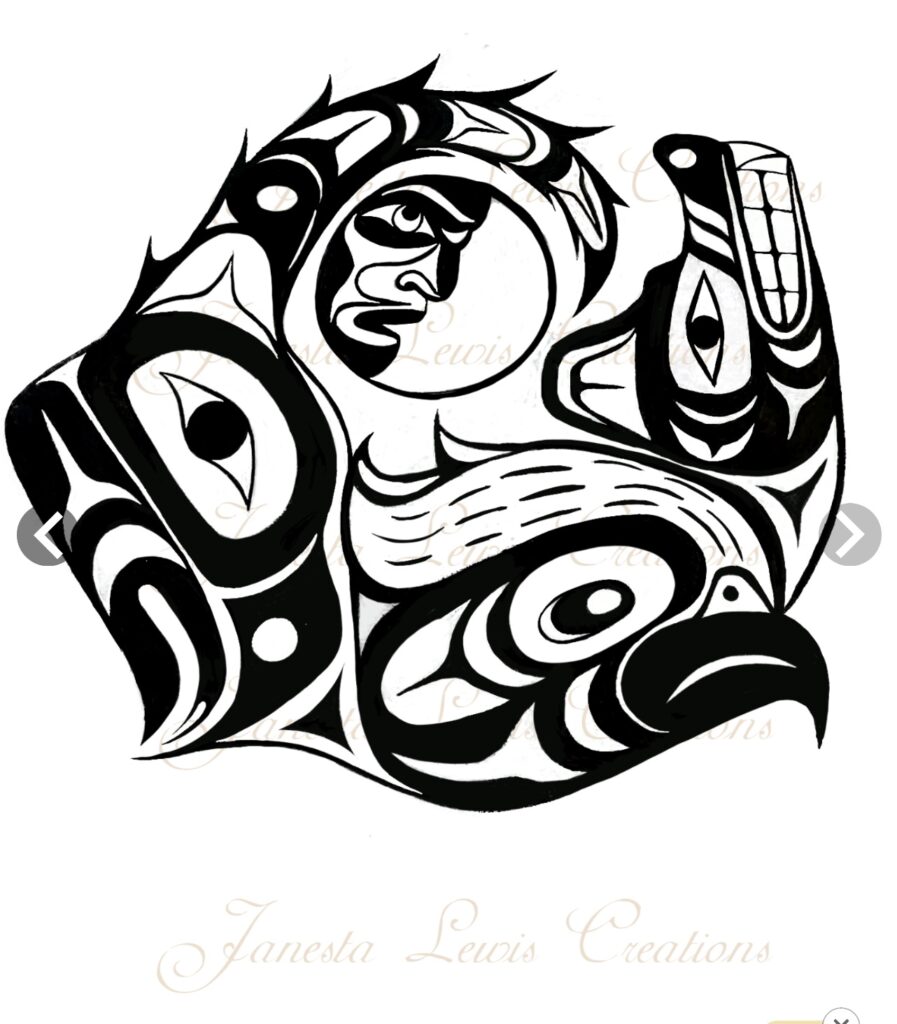
Coast Salish Shapes
LEARNING INTENTIONS
Students will learn to:
- Identify crescents, trigons, ovoids and circles in Coast Salish artworks
- understand how these shapes create balance, movement, and flow
- use these shapes to design their own nature-inspired artwork
- And eventually create original designs
INTRODUCTION
1. Examine Artwork
Show students a few examples of Coast Salish art
Ask:
“What shapes do you see repeating?”
“Where do you notice symmetry?”
“How do the lines flow?”
Introduce the three key shapes:
- Ovoid – rounded, soft oval
- Circle (common circle)
- Trigon
- Crescent
GUIDED PRACTICE
Practice Drawing the Shapes
On scrap paper, guide students to draw:
4–6 ovoids (large and small)
4–6 circles (single, overlapped, nested)
4–6 trigons (flowing in different directions)
4–6 crescents
Ask:
“Which shape is the easiest for you?”
“Which one creates the most movement?”
Step-by-Step:
1. Sketch the Outline
Students draw a simple outline of their plant or animal.
2. Fill the Shape with Ovoids, circles, trigons and crescents
CLOSING
Whole-class reflection:
“Which shapes did you use the most?”
“How did you make your design flow?”
“What part of Coast Salish art inspired you?”
ASSESSMENT (Teacher or Self-Assessment)
Checklist:
□ I used ovoids in my design
□ I used circles in my design
□ I used circles in my design
□ My design is based on a local plant or animal
□ I created flow, balance, or symmetry
□ My artwork is original and respectful